Should You Change the Thumbnail on an Old YouTube Video?
Changing an old YouTube video's thumbnail can help if the new package gives the right viewer a clearer reason to watch. It does not automatically restart distribution or give the upload a fresh algorithmic launch.
YouTube explains that changes can affect performance because viewers respond differently to the new presentation, rather than because the act of editing a title or thumbnail creates a ranking reset.
Source: YouTube Help — YouTube performance FAQ
The useful question is therefore: does this video still offer something valuable that its current package communicates poorly?
Start with relevance
Watch the video again before editing its thumbnail. Is the advice still accurate? Does the product still exist? Is the central question still interesting to the audience you want to reach?
A timeless tutorial with a vague title is a plausible candidate. A product announcement whose news value has expired may need a new follow-up video. Packaging cannot repair a promise that the old content no longer fulfills.

Choose between keep, test, and remake
This is an editorial decision framework, not a formula for predicting views.
| Situation | Suggested action | Reason |
|---|---|---|
| Still useful, but the image hides the main result | Test a clearer package | You can state a specific communication problem |
| Performing satisfactorily for its intended audience | Keep it unless you have a clear hypothesis | A redesign needs a reason beyond personal boredom |
| Packaging promises something the opening does not deliver | Review both promise and content | More clicks may not solve the mismatch |
| Main information is obsolete | Update or remake the content | The underlying value needs attention |
| Very little relevant traffic or evidence | Investigate demand and distribution first | There may be insufficient exposure to evaluate a packaging change |
Look at a current window
An old video's lifetime total can conceal whether anyone is encountering it now. Review its recent traffic and compare like periods. Note the source of that traffic; YouTube Analytics distinguishes discovery through search, suggested videos, browse features, and external sources.
Source: YouTube Help — YouTube Reach reports
For a recent change, save the original title, thumbnail, date, and reason. This makes it possible to interpret what happened later instead of relying on memory.
Redesign the promise before the decoration
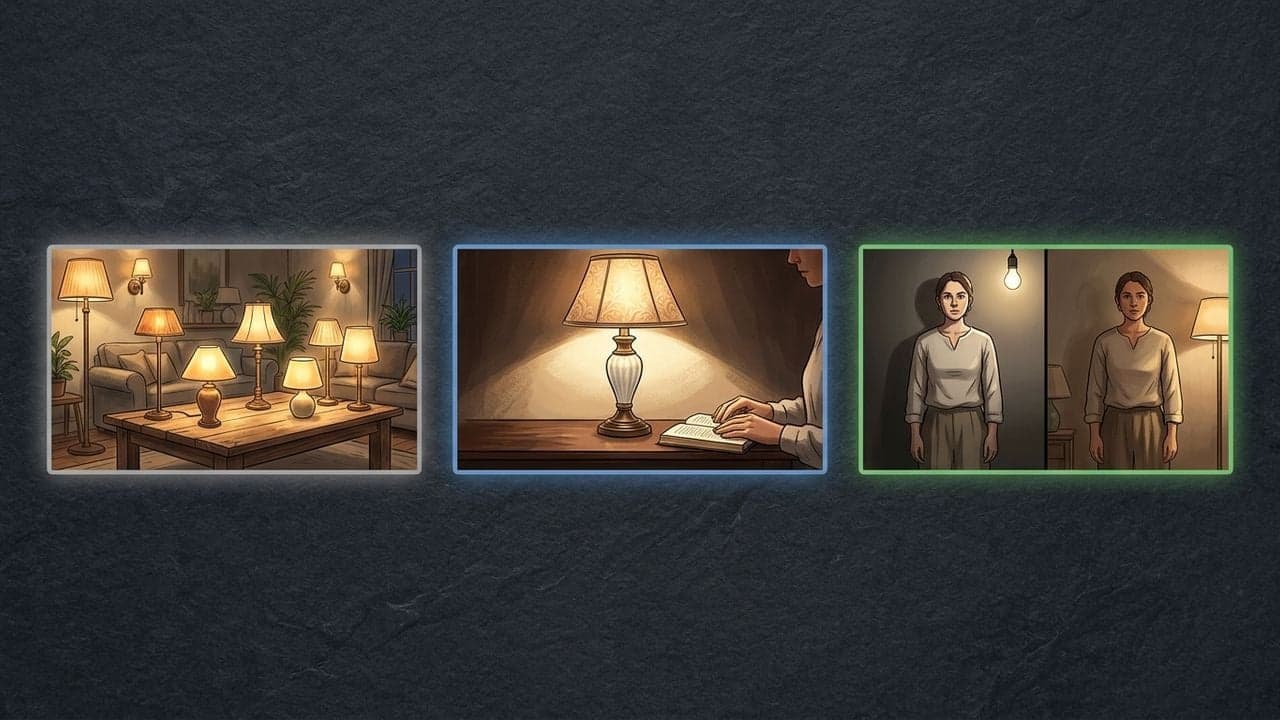
Imagine an evergreen tutorial that shows how to light a small room for filming. Its original title is "My Lighting Setup," and the thumbnail shows several pieces of equipment. The content's useful insight is that the placement of a single lamp makes the subject easier to see.
Three illustrative alternatives might be:
- Outcome: "Better Video Lighting in a Small Room." Show the resulting frame.
- Constraint: "A Small-Room Lighting Setup With One Lamp." Show the lamp and subject relationship.
- Mistake: "The Lamp Placement That Was Ruining My Videos." Show the problematic placement alongside the corrected one.
These are different reasons to watch. Choose only promises supported by the actual tutorial. Adding a large arrow to the original equipment photo is a different design, but it may leave the underlying communication problem untouched.
Write down what would count as useful evidence
A before/after increase in views can be encouraging without proving the redesign caused it. Audience composition, outside mentions, seasonality, or renewed interest in the topic may have changed at the same time.
Use a controlled comparison where available and avoid repeatedly editing a package before you can interpret the previous change. If evidence stays weak, record the uncertainty instead of declaring a winner.
Do you need to delete and reupload?
For a packaging-only experiment, keep the existing video and update its presentation. Reuploading creates a different situation and makes comparison harder. If the content itself requires substantial correction, decide whether a new version is appropriate on that basis.
You do not need to repackage every old video. Start with one that remains relevant, has a clear communication issue, and offers a useful lesson for future uploads.
Use FrameOne's free audit to find public performance patterns and videos worth a closer look. Treat the shortlist as the beginning of an investigation, then use your own analytics to decide what deserves a test.